


How a Torque Tool Actually Works Subsea

Mark Harris
Manager - Technical Sales
August 6, 2026
10 min read
A subsea tree manifold is made up of many valve types, with the main two that ROV’s interface with being rotary valves that turn clockwise and counterclockwise and Linear valves that are pushed open by a hydraulic ram against a spring that closes them automatically when force is released.
Both types require accurate ROV operation to avoid potential equipment damage and as an ROV has no sense of resistance or force being applied, specialised interface tooling is required.
In this discussion we are focussing on rotary valves.
The valve bucket
For rotary valve operations the torque tool engages into an ISO / API valve bucket: a standardised component on the tree that the torque tool nose enters to engage with the valve stem. The bucket has cut outs for the torque tool reaction dogs to latch into when the torque tool is fully engaged with the valve stem. Once locked, those dogs prevent the tool from falling out or rotating freely as rotational torque is applied.
“If you’re turning the tool clockwise and it has nothing to react against, it will just start spinning. The bucket captures it. The tool is fixed, and when you turn the valve stem, you are turning the valve.”
— Mark Harris, TMT
Subsea trees carry valves across multiple classes, each with different stem sizes and torque ranges that are matched to the manufacturer stated operational and damage torque of the valve. The bucket interface is standardised to those classes, which is why the standards covered in Episode 1 of this series matter in practice. An ROV Pilot Technician who doesn’t know whether they’re dealing with an ISO / API Class 1, Class 2, Class 3 , Class 4 etc valve are going in blind.
Operating it
The ROV‘s right arm, typically a Titan T4 manipulator originally developed for pulling fuel rods in nuclear facilities, picks up the torque tool, offers it up to the bucket, rotates the drive nose while pushing forward to engage with the valve stem, and then operates latching dogs. The operator can now run the specified torque operation with real-time surface readout showing applied torque and number of turns. When the operation is complete, the torque tool can be unlatched, removed from the bucket, and parked ready for the next operation.
This type of torque operation using the manipulator is referred to as free flying and the ROV pilot technician can operate all rotary valves on the tree manifold that are in both horizontal and vertical orientations.
The rotary torque tool is also used to engage Electric Flying Leads (EFL’s) and Hydraulic Flying Leads (HFL’s) into the tree umbilical termination assembly (UTA) and Subsea Distribution Unit (SDU)
These umbilicals with cobra head place significant load onto the ROV’s orientation as it manoeuvres to engage into the SDU or UTA MQC plates
These loads are what drove the development of the FLOT.
The Flying Lead Orientation Tool (FLOT)
When a new well ties into existing subsea infrastructure, EFL / HFL must be connected between manifolds via a cobra head / MQC plate – a heavy connection point carrying hydraulic and or electrical circuits that must stab simultaneously into a receiving panel.
Cobra heads are heavy. Picking one up shifts the ROV’s centre of gravity. The connection requires square alignment, and the operator is working from a two-dimensional screen.
To overcome this challenge the following operational tooling was developed.
The torque tool is mounted to the FLOT which is in turn is mounted to the front frame of the ROV. This frees up both left and right manipulators to assist in the umbilical and MQC plate pull in.
The FLOT design has pitch and roll functionality that allows the operator to correctly align the heavy EFL / HFL and termination head no matter what the orientation of the ROV is. This makes for a fast and reliable operation that also prevents damage to this expensive critical subsea infrastructure.
“The ROV starts to lean over, and if it is not square, they will not be able to engage it. The FLOT does the adjusting, squares everything up, and then they drive forward and engage.”
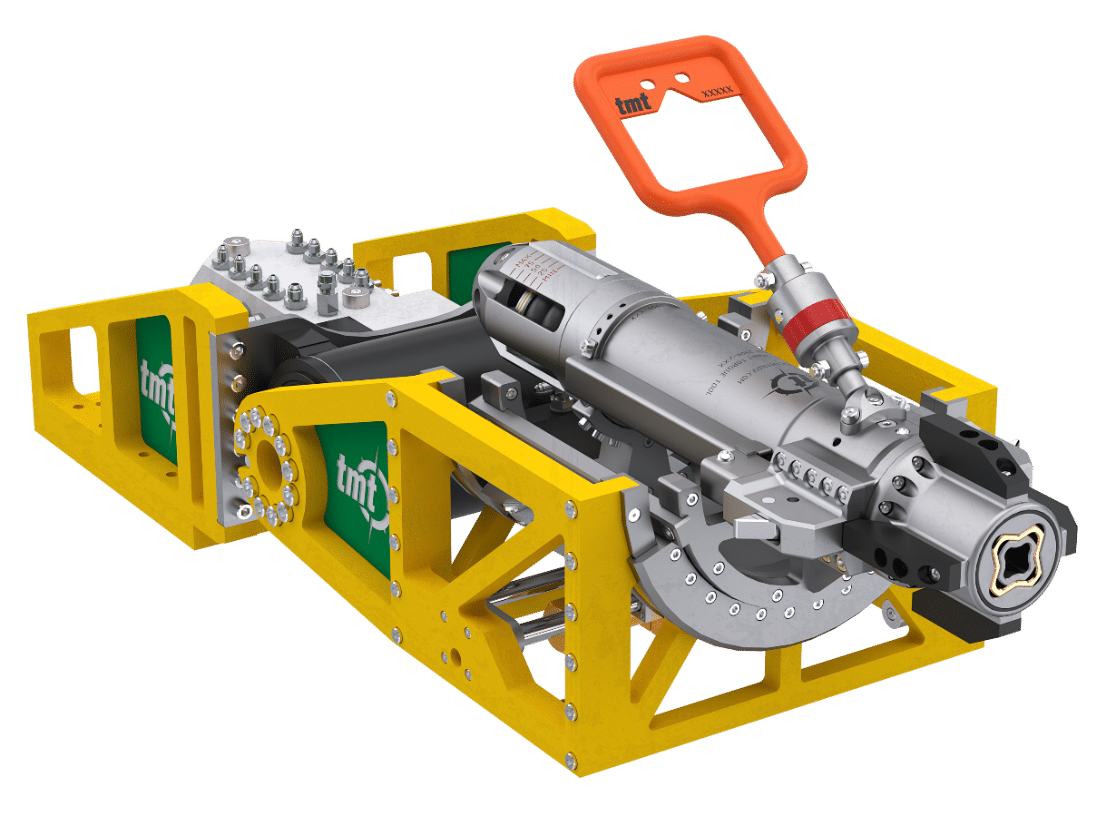
TMT’s current design goes further: the torque tool can de-latch from the FLOT subsea, complete a free flying valve operation on the same manifold, and re-latch into the FLOT without performing a time consuming transit back to the surface to change tooling configuration.
What sets TMT apart
Most torque tool suppliers build the equipment and hand it over. TMT manufactures the tools and deploys them on jobs. That distinction matters more than it might appear.
TMT’s current FLOT design eliminates that transit. The torque tool de-latches from the FLOT subsea, the valve operation is completed, and the tool re-latches into the FLOT frame, all without surfacing. The FLOT then parks clear of the ROV’s path.
What’s coming up next episode
We’ll explore what happens when the standard torque range isn’t enough. Adapters, stuck valves, and what happens when you need to go beyond class four. See you next week.
Find out how TMT can engineer the solutions & tools you need

We’re always looking for more talented team members who can help us shape the future of subsea engineering.
TMT © 2026 | Sitemap | Terms & Conditions | Privacy Policy
Managed by 3BY2