


When Saws Won’t Cut It: A look into TMT's
cutting equipment range

Mark Harris
Manager - Technical Sales
June 25, 2026
10 min read
Our cutting story doesn’t start with a circular saw. It starts with Italian marble.
Where diamond wire came from
In the early 1990s, an Italian company developed diamond wire to cut marble at cliff faces. A wire embedded with diamond segments runs continuously around a series of idler wheels, clamping onto the material and cutting through it progressively. The marble industry used it to extract precise blocks from rock faces to be sliced into flooring and building panels.
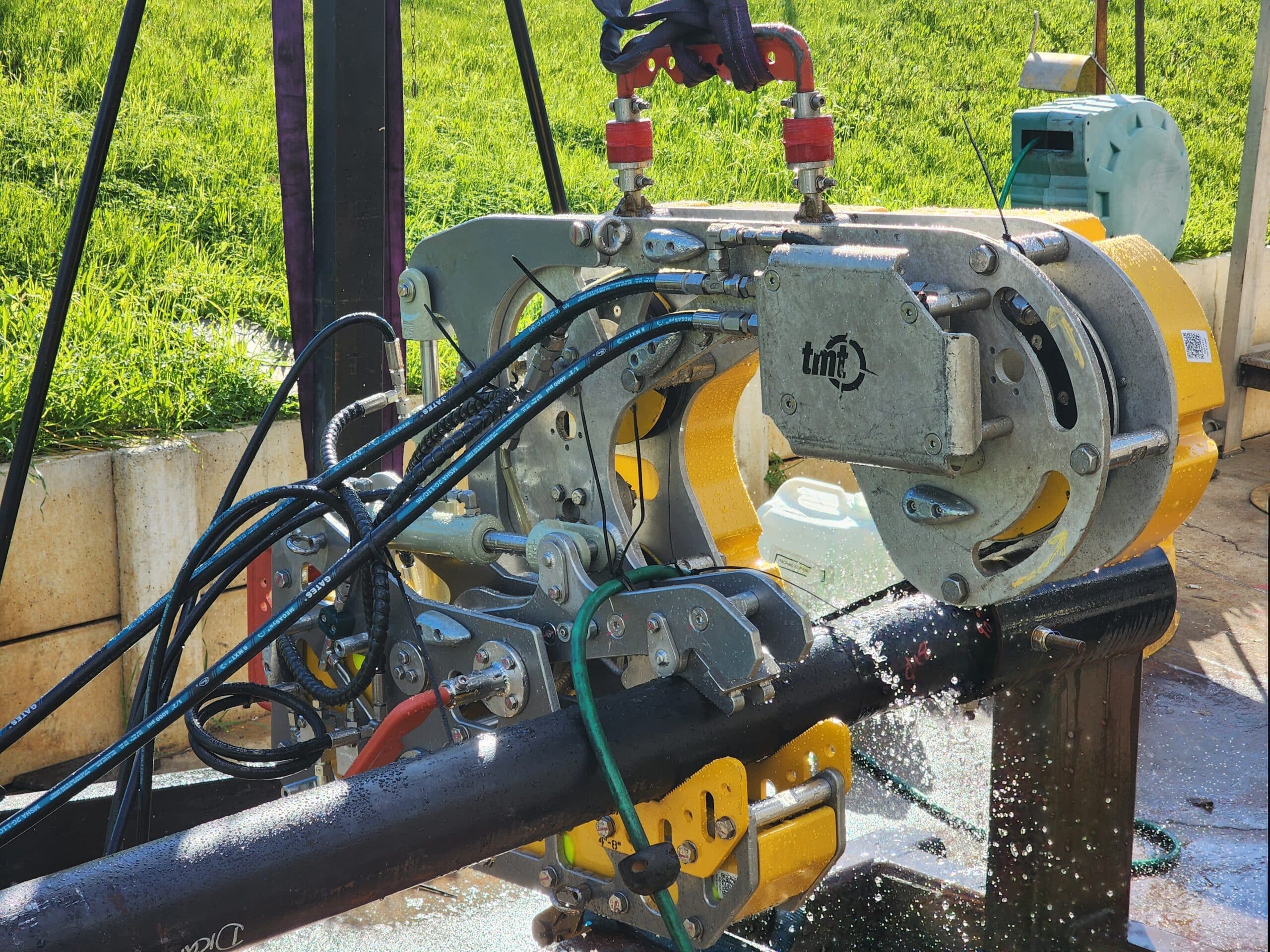
It’s now a near-commoditised approach in the industry. TMT owns diamond wire saws from 4 to 30 inches in diameter, used as either a primary cutting method or backup alongside the chop saw, depending on the target material and geometry.
Between the guillotine cutters, the chop saw and the diamond wire, TMT has cutting coverage from 22mm wire rope up to 30-inch conductors. That didn’t appear overnight. Our range has accumulated across decades of real jobs, each one adding to what TMT knows about what works.
Cutting below the seabed: the AXE
Decommissioning is a growth area. When a field reaches end of life, the obligation is to remove the subsea infrastructure (trees, conductors, wellheads) so that returning fishing grounds aren’t left with hazards on the seabed.
The challenge with a well conductor is its structure. It’s a telescope: a 30-inch outer conductor with a 20-inch cemented inside it, then a 13 3/8 -inch, then a 9⅝-inch. Each section cemented into the next, running hundreds of metres into the seabed. Cutting it means cutting through layers of steel, cement, steel, cement. Rinse and repeat.

TMT’s AXE system goes into the wellhead, lands, and cuts the entire casing string in a single pass, approximately three to four metres below the seabed. It has a strong track record across multiple decommissioning campaigns, including all seven Shell Prelude wells that were being permanently abandoned.
It becomes most cost effective at scale. For a multi-well campaign, the economics work decisively in its favour.
Going smaller: the Mini Axe
A consistent request TMT kept hearing was whether there was an option for smaller conductors – jacket legs, caissons, situations where the full AXE system is too large. The answer is now yes.
The Mini Axe operates at ultra-high pressure using water jet cutting, with a centralising arm system that stabilises the cutting head inside the conductor before the cut begins. It’s heading out on its first deployment soon.

The Terminator Skid
Baker Hughes developed a cutting tool called the Terminator – knives that deploy hydraulically, rotate and cut from inside a conductor. The concept is strong, but running it successfully from an ROV in this region has proven difficult for others because the tool demands very specific hydraulic parameters: high flow and pressure ranges and real-time monitoring that most ROV setups can’t consistently deliver.
TMT has adapted one of its BOP skids into a Terminator-compatible platform, giving it the hydraulic control and monitoring capability the tool actually needs to perform. Factory acceptance testing has been completed with Baker Hughes present, and it’s mobilising shortly for its first job.
Explore and learn more about our Cutting Equipment range here.
Find out how TMT can engineer the solutions & tools you need

We’re always looking for more talented team members who can help us shape the future of subsea engineering.
TMT © 2026 | Sitemap | Terms & Conditions | Privacy Policy
Managed by 3BY2